Most people who say they’d like to write a book don’t actually want to write a novel.
They want to write about something that happened. The war they’ve read about for twenty years. The disaster they can’t stop watching documentaries about. The expedition, the siege, the trial, the family story that turns out to be bigger than anyone thought.
That’s narrative history: true stories about real people, told with the pull of a novel. Think Erik Larson, Nathaniel Philbrick or Ben Macintyre. And it has a far bigger audience than most self-publishers assume. In a 2025 YouGov survey of Americans who’d read a book that year, history came out ahead of fantasy, romance and thrillers.
This guide covers how to write narrative history from the very start: choosing a subject that will sell, finding primary sources (most of them free), staying on the right side of copyright, and planning a series rather than a one-off book.
What Narrative History Actually Is
A textbook tells you what happened. Narrative history puts you inside it.
It uses the tools of fiction, such as scenes, characters, tension and point of view, but every one of them has to be supported by evidence. The people are real. The dialogue comes from letters, diaries, testimony and memoirs, not from your imagination. When the sources disagree, you say so.
That last part is what separates it from historical fiction. A novelist can invent a conversation that probably happened. A narrative historian can’t. The good news is that real people wrote down far more than most readers realise, and the gaps and contradictions in their accounts are often where the best scenes are.

Step 1: Choose A Subject That Passes Four Tests
This is the decision that makes or breaks the whole project, and most first-time authors make it on enthusiasm alone. Enthusiasm matters, because you’ll live with this subject for months. But it needs to pass four tests first.
1. Readers
Is there an existing audience buying books on this subject? Search Amazon for the subject and look at what comes up. You want to see several books with healthy review counts, which proves demand, and ideally some that are old, thin or badly reviewed, which leaves room for you.
Famous subjects aren’t automatically a bad idea. The Alamo and the Titanic have huge shelves, but they also have huge readerships who buy book after book. A fresh angle on a famous subject often sells better than a perfect book on something nobody’s searching for.
2. Evidence
Narrative history runs on first-hand sources. Before you commit, check that people who were there left letters, diaries, reports, testimony or memoirs, and that you can actually get hold of them. Some subjects that look ideal turn out to have almost nothing in writing from the participants.
3. Series
One book is a lottery ticket. Three connected books start to look like a catalogue, because readers who finish book one buy book two, and every new release lifts the ones before it.
The easiest way to build a history series is around three turning points in one larger story: three battles in one war, three stages of one expedition, or before, during and after one disaster.
4. Rights
Can you legally quote the sources? This one catches people out, so it gets its own section below.
Step 2: Find Your Primary Sources
A primary source is anything written by people who were there, or at the time: letters, diaries, journals, official reports, sworn testimony, treaties, newspaper reports and memoirs.
Most first-time history writers have no idea how much of this is free and already typed up. You rarely need to squint at scans of old handwriting. These are the places to start:
| Source | What you’ll find | Best for |
|---|---|---|
| Project Gutenberg | Thousands of old memoirs, journals and histories as clean text | Memoirs and older histories |
| Internet Archive | Scanned books with a downloadable “full text” version | 19th-century sources |
| HathiTrust | Millions of digitised library books, many in full view | Hard-to-find editions |
| Founders Online | Transcribed papers of Washington, Jefferson, Franklin and others | American Revolution era |
| The Avalon Project (Yale) | Treaties, declarations and constitutional documents | Official documents |
| Library of Congress | Manuscripts, letters, maps and exhibition transcripts | American history |
| State and national archives | Official reports, inquiries and local records | Specific events and places |
A tip that saves hours: when you find a good modern book on your subject, go straight to its bibliography. It’s a ready-made map of the primary sources, compiled by someone who has already done the digging.
Question every source
For each source, ask three things. Who wrote it? How close were they to the events, both in distance and in time? And what reason might they have had to shade the truth?
A general’s official report, written to explain a defeat, will not tell the same story as a private soldier’s diary. A memoir written fifty years later will be vivid and wrong about details. Neither is useless. You just need to know what you’re holding.
When two eyewitnesses disagree, don’t quietly pick one. Show the reader both. “Who fired first?” has been argued about at Lexington for 250 years, and that argument is more gripping than any confident answer would be.
Step 3: Stay On The Right Side Of Copyright
“Free to read online” is not the same as “free to use in a book you sell”. Here are the rules that matter most.
- The original document and the edition are different things. A letter written in 1777 is out of copyright. A modern annotated edition of it, or a modern translation, may well not be.
- US public domain: as of 2026, works published in 1930 or earlier are in the public domain in the United States. US federal government documents, such as official reports and Senate inquiry testimony, are public domain too.
- UK public domain works differently: generally the author’s life plus 70 years. A memoir published in 1912 by someone who died in 1967 is free in the US but still in copyright in the UK until 2038. That’s exactly the situation with one of the best-known Titanic survivor accounts.
- Translations count. Ancient and foreign-language sources are only as free as the translation you’re using.
The safe working habit: use every source for facts, paraphrase modern editorial material, and quote directly only from texts you’ve confirmed are public domain where you’re selling. (This isn’t legal advice. When it really matters, check the specific edition.)

Step 4: Plan The Series Before You Write
Once you have a subject, map out all three books before you write chapter one. For each book, decide:
- Scope. Where it starts and where it ends.
- Point of view. Two or three real people whose eyes the reader will see through, ideally on different sides.
- The climax. The event the whole book builds toward.
- The bridge. The moment at the end that makes the reader want the next book.
The bridge is what turns three books into a series. At the end of a Texas Revolution book one, the town of Gonzales has fired the first shot of the war. Two books later, it’s the same town that sent the last reinforcements into the Alamo. Real history is full of threads like that, and readers love them.
Step 5: Write Scenes, Not Summaries
The difference between history people skim and history people can’t put down is the scene. Put the reader somewhere specific, at a specific moment, with someone who doesn’t know how it ends.
Keep the rules strict, though. Use only words the sources record. Describe what the evidence supports. When you’re inferring something, say so: “he must have seen”, “according to his own account”. Readers of narrative history trust you more for it, not less.
Then build the material around the story: a cast list, notes on sources, and a selected bibliography. It’s what readers of the genre expect, and it’s what earns the good reviews.
A Tool Built For Both Halves Of The Job
All of the above is a lot of work, and the research is where most would-be history authors stall.
History Co-Author is a new framework from Søren Jordansen, the creator of Cozy Co-Author and Steamy Co-Author, built specifically for narrative history. It works as a co-researcher, finding sources, questioning who produced them, comparing conflicting accounts and keeping a research record. It also works as a co-author, shaping that evidence into chapters while keeping the story tied to what the sources support. It builds the cast list, chapter notes and bibliography too.
The front end includes the framework, the training and Narrative History Studio, which adds plugins for Claude Cowork and ChatGPT Work. Søren used it to publish his own three-book series, Forgotten Wars of American Expansion, and the free samples on Amazon are worth reading before you decide.
The honest verdict
What it does well: it takes the research seriously. Most AI writing tools are built for fiction, where nobody checks your facts. A framework built around source critique and evidence is a different, more useful thing for this genre.
What it doesn’t do: it won’t choose your subject, and it won’t market your book. It also won’t replace your judgement about which source to trust. That’s still your job, and it should be.
The realistic picture: Søren’s own royalty screenshot for his series shows real but modest earnings rather than overnight riches, which is honest. Most self-published authors earn little in any genre. What improves the odds is a subject with existing readers, planned as a series, built on solid sources.
That’s the thinking behind my bonus, with one twist: it’s exclusive.
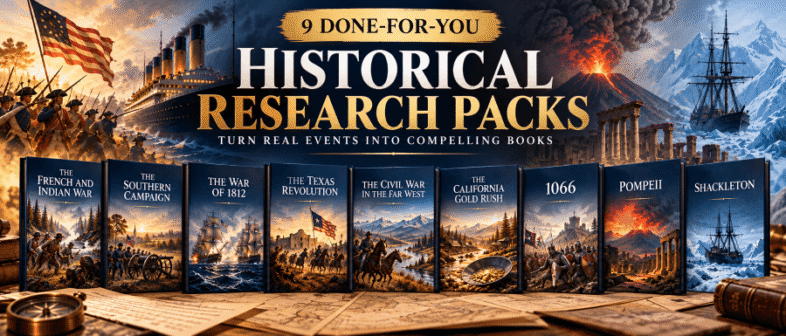
I’ve built nine done-for-you research packs, from the Alamo and the Gold Rush to 1066, Pompeii and Shackleton. Each one is a complete three-book series plan, with the timeline, key figures, point-of-view characters and eyewitness sources linked, and copyright status flagged.
But each pack goes to one buyer only. If you pick up History Co-Author through my link, you choose one of the nine, and once it’s claimed it’s yours alone. I won’t give it to anyone else or reuse it in another bonus. A done-for-you plan is only worth so much if a hundred other people are writing the same series from it.
It’s strictly first come, first served, and claimed packs are marked on the bonus page, so you can see exactly which ones are still available.
See History Co-Author and which packs are still available ?
Frequently Asked Questions
What is the difference between narrative history and historical fiction?
Historical fiction can invent characters, dialogue and events. Narrative history can’t: every person, quote and event has to be supported by evidence, even though it uses storytelling techniques like scenes and point of view. If the sources disagree, a narrative historian tells the reader.
Do I need a history degree to write narrative history?
No. Many of the best-selling narrative historians are journalists or writers rather than academics. What you need is curiosity, care with sources, and the discipline not to invent. Readers of the genre care far more about a gripping, well-sourced story than about credentials.
Where can I find free primary sources?
Project Gutenberg, the Internet Archive, HathiTrust, the Library of Congress, Founders Online and the Avalon Project are the best places to start. Many government records, such as official inquiries, are public domain and published online in full. The bibliography of a good modern book on your subject is the fastest map to the sources.
Can I quote old letters and diaries in a book I sell?
Usually, if they’re old enough. In the US, works published in 1930 or earlier are public domain as of 2026. In the UK the general rule is the author’s life plus 70 years. Watch out for modern editions and translations, which can carry their own copyright even when the original is free.
How long should a narrative history book be?
For self-published narrative history, 50,000 to 80,000 words is a comfortable range per book. A focused subject told well beats a long one padded out. Planning a series of three shorter books often serves readers better than one enormous one.
The Short Version
Choose a subject that passes four tests: readers, evidence, series potential and rights. Find the primary sources before you commit. Most are free and already transcribed.
Question every source, show the reader where the eyewitnesses disagree, and quote only what you’re sure is public domain where you’re selling.
Then plan three books, not one, with a bridge at the end of each, and write scenes rather than summaries. The past already has an audience. Your job is to give it a story worth reading.
Disclosure: this post contains affiliate links. If you buy through one of them I earn a commission at no extra cost to you.