Ask an AI to “write a science fiction story” and you’ll get something. It’ll have a spaceship, probably. Someone will gaze at the stars. Everything will be resolved neatly in the last paragraph.
It won’t be something anyone wants to read twice.
The good news is that the problem isn’t really the AI. It’s the brief. AI is very good at following a clear plan and very bad at inventing one. Give it a vague request and you get vague fiction. Give it a strong premise, firm rules and a page-by-page structure, and the results improve dramatically.
This guide shows you how to write science fiction with AI properly: finding a premise worth writing, keeping the AI consistent, drafting page by page, editing out the “AI mush”, and getting the finished story found on Amazon. At the end I’ll look at a new tool built for one particularly good corner of the genre.
Start With a Premise, Not a Request
The best science fiction usually starts with a “what if” that makes the reader slightly uneasy. Not “a story about space”, but “what if a deep-space mission found something humanity was never meant to bring home?”
One of the strongest families of premises is science gone wrong: an experiment that fails, a discovery that spirals out of control, a breakthrough with a terrible cost. It’s a sub-genre with a long pedigree, from Frankenstein onwards, and it works because the reader can feel the disaster coming before the characters do.
A strong premise has three parts:
- The breakthrough. What did someone achieve or discover?
- The cost. What does it do that nobody expected?
- The clock. Why does it have to be dealt with now?
“A climate engineering project designed to cool the planet starts freezing the oceans, and the team that built it has six days before the effect can’t be reversed.” That’s a premise an AI can work with.
Write a One-Page Story Bible
The biggest complaint about AI fiction is drift. Characters change names. The science contradicts itself. A minor character suddenly becomes the hero. This happens because the model loses track of decisions it made earlier.
The fix is a one-page story bible that you paste in before you start, and again whenever the draft wanders.

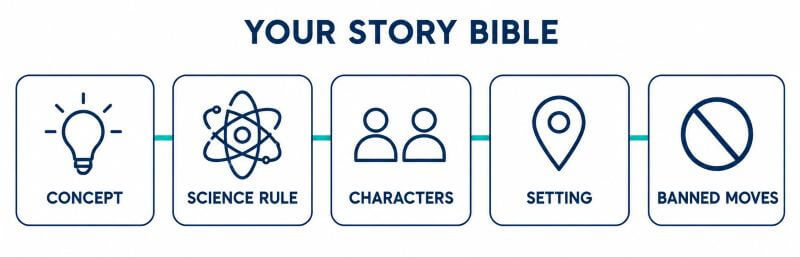
- Concept: your premise in one sentence.
- Science rule: one clear rule for how the forbidden science works and what it costs. This single line prevents most plot holes.
- Characters: the lead (what they want, what they fear, one flaw) and two or three supporting characters.
- Setting: where and when, in two lines.
- Banned moves: things you don’t want, such as “no last-minute rescue by the government”.
Outline Before You Draft
Never ask the AI to write the whole story in one go. Ask it for an outline first, review it, fix it, and only then start drafting.
For a short story, a page-by-page outline works well. A 14-page structure gives you room for a proper arc:
| Pages | What happens |
|---|---|
| 1–2 | The world before, and the discovery or experiment |
| 3–6 | Warning signs, a failed fix, the danger grows |
| 7–10 | Crisis: the point of no return |
| 11–14 | The climax, the cost and the ending |
Read the outline as a reader would. Does the danger escalate? Does the lead make choices, rather than just watching things happen? Is the ending earned? Fix it now, while it’s cheap to change.
Draft Page by Page
Once the outline is right, ask for one page at a time. It keeps the AI focused and gives you a natural point to check its work.
Prompts that help:
- “Please create page 3. Around 600 words. Continue directly from page 2. Keep all names, facts and the science rule exactly as established.”
- “Before writing page 7, summarise what has happened so far in five bullet points and list every named character. Then write page 7.”
- “Page 12 resolves too quickly. Add one setback before the final decision.”
Review every three pages. Problems compound, so catching drift early saves a lot of rewriting.
Edit Out the AI Mush
Even a well-planned AI draft has tell-tale habits. Readers notice them, and reviewers mention them. Do four quick passes rather than one long one:
- Story: does every page move things forward?
- Consistency: check names, facts and the science rule against your story bible.
- Voice: cut repeated phrases and clichés.
- Polish: spelling, punctuation and formatting. Reading it aloud helps.
Common AI tics to hunt for: characters “letting out a breath they didn’t know they were holding”, every scene ending on a dramatic one-liner, eyes constantly widening, and tidy summary paragraphs at the end of chapters. Ask the AI to list phrases it has used more than three times, then fix them.
Short Story, Novella or Series?
A finished 14-page short is a perfectly good product. But it’s worth thinking bigger.

- Short story (5,000–10,000 words): quick to finish, good for testing a premise.
- Novella (20,000–30,000 words): expand the same outline into 12–15 chapters by adding a life-before scene, a failed fix, a human antagonist, a personal cost and a quiet moment before the climax.
- Series: disasters naturally have a before, during and after. One concept can become an escalation trilogy: the lab, the city, the world.
- Collection: once the series is out, bundle it into one longer book.
Series matter because of read-through. A reader who finishes book one and finds book two waiting will often buy it. One standalone story is a single sale; a series is a chain of them.

Getting Found on Amazon
If you publish on Kindle, two settings decide whether sci-fi readers ever see your book: categories and keywords.
- Categories: KDP lets you choose up to three. Choose by genre first (hard science fiction, technothriller, dystopian, medical thriller), then theme. Go as specific as you honestly can.
- Keywords: you get seven boxes. Use reader phrases rather than single words: “lab experiment gone wrong”, “climate disaster novel”, “rogue AI thriller”. No author names, brands or sales language.
- Subtitle: let it describe the book honestly, for example “A Climate Engineering Thriller”.
One last thing: KDP asks you to disclose AI-generated content when you publish. If the AI wrote the draft, answer that honestly, even if you edited it heavily.
A Shortcut: Forbidden Science Prompt Generator
Everything above works with any AI assistant. The slowest part, especially when you’re starting out, is coming up with strong premises and turning them into a structured brief.
Forbidden Science Prompt Generator, from Francis Ochoco and Diego Duarte, is built for exactly that, in the science-gone-wrong sub-genre. Here’s what it does:
- 300 story concepts across 30 categories, from containment failures, quantum anomalies and nuclear disasters to climate engineering, lab-created pathogens, dimensional breaches and deep space missions
- settings for story tone, ending style and scientific plausibility
- a “Copy Prompt” button that hands your AI assistant a full brief
- the prompt asks for a title, an Amazon-ready description and a page-by-page outline for a 14-page short story, which you then draft one page at a time
- category browsing, search and favourites
Upgrades add more categories, including bioengineering and genetics, artificial intelligence, military black projects and climate manipulation. All editions are Personal Use Rights only, so it’s for writing your own stories, not for reselling the app.
My Verdict
It’s a focused tool, and that’s its strength. It doesn’t pretend to write a finished book for you. What it does is remove the two steps people find hardest: coming up with a premise that’s genuinely gripping, and turning it into a structured outline the AI can follow. Its page-by-page approach is the same method I’d recommend anyway.
You’ll still need to do the work this guide describes: a story bible, careful drafting and proper editing. But if you like the idea of writing gripping “what if” science fiction, it gives you 300 strong starting points and a sensible structure for each.
My Bonuses If You Pick It Up
If you buy Forbidden Science through my link, I’ll send you three reports that pick up where the app leaves off:
- Outline to Finished Novella: finish the 14-page draft properly, then expand it into a novella
- Sci-Fi KDP Categories & Keywords Cheat Sheet: categories and seven keyword phrases for each of the app’s themes
- One Concept, Three Books: turn one concept card into a connected series, plus a collection
See Forbidden Science and my three bonuses here ?
Frequently Asked Questions
Can AI write a good science fiction story?
It can write a good draft if you give it a strong premise, clear rules and a structured outline, and then edit the result. Left to its own devices, it tends to produce generic, predictable stories.
Which AI is best for writing fiction?
Most mainstream assistants, including ChatGPT and Claude, can draft fiction well when given a detailed brief. The quality of your brief and your editing matters more than the choice of tool.
Can I publish AI-written stories on Amazon?
Yes, but KDP asks you to disclose AI-generated content when you publish, and the book must meet its content guidelines. Check the current rules before you upload.
How long should a sci-fi short story be?
Typically somewhere between 5,000 and 10,000 words for a story you’d publish on its own. A novella is usually 20,000 to 40,000 words.
Disclosure: this post contains affiliate links. If you buy through one of them I earn a commission at no extra cost to you.