Last week I needed a name for a new product, so I did what most of us do now. I asked ChatGPT. Then, for good measure, I asked Claude.
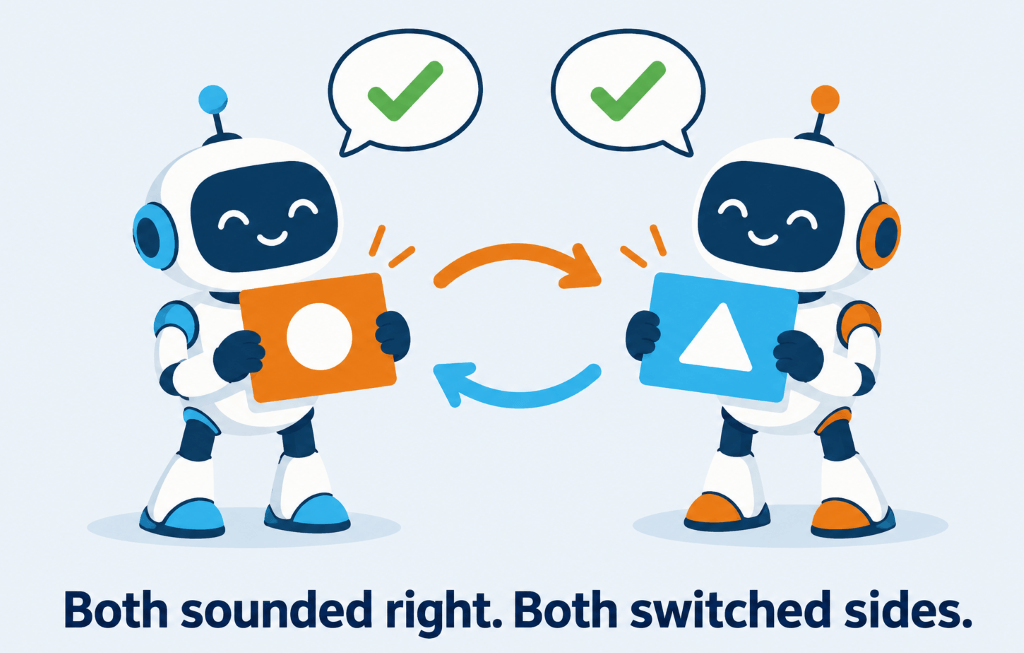
They picked different names. Fair enough. So I showed each one the other’s reasoning.
They both switched sides.
Two very capable AI models, two completely convincing arguments, then two U-turns. If I’d only asked one of them, I’d have happily gone with whatever it told me, and I’d have felt quite confident about it.
That little episode explains a problem that is quietly costing marketers money. AI is now so good at arguing a case that it can make almost any
sales angle sound right. And when every angle sounds right, the one that actually leads your campaign tends to be whichever one you happened to prompt first.
In this post I’ll show you how to choose the right sales angle
before AI writes a word: the five angles every offer can be sold on, a simple evidence-first way to pick between them, a real worked example, and how to brief AI once the decision is made.
What is a sales angle (and why does it matter more now)?
A sales angle is the main argument your marketing makes for why someone should buy. It is not the headline, and it is not the copy. It is the decision that sits underneath both:
what is this campaign actually arguing?
The same offer can be sold on very different arguments. A course could lead with the pain of staying stuck, the result people want, the clever method behind it, how quick it is, or the proof that it works. Each of those produces a different headline, a different opening, a different email sequence and a different ad.
Before AI, choosing an angle was slow but visible. A copywriter would argue for one, someone would push back, and the weak ideas usually looked weak on the page. Now you can type a vague prompt and get a polished sales page in thirty seconds. That’s brilliant for speed. It’s not so brilliant for judgement, because the angle often gets chosen without anyone noticing a choice was made.
Why AI makes the wrong sales angle look right
Bad marketing used to look like bad marketing. That’s no longer true, for three reasons.
1. Good writing gives any idea credibility
Fluent, confident copy makes an argument feel stronger than it is. AI writes fluent, confident copy about anything, so a weak angle arrives wearing a very nice jacket. The wrong sales angle no longer looks obviously wrong.
It looks finished.
2. More generations create more uncertainty, not less
Ask for another angle. Then another. Try a different model. Combine the best bits. You end up with seven plausible campaigns and considerably less certainty than when you started, because each one came with a perfectly reasonable justification attached.
3. Preference quietly becomes strategy
Eventually someone says “I like this one”. That’s a fine way to choose wallpaper. It’s a questionable way to decide what an entire campaign is going to argue, especially when you’re about to spend money on design, traffic or a launch.
And if you think the answer is to ask AI which angle is best, remember my naming experiment. AI is remarkably good at building a persuasive case for whichever option is currently being discussed. It’s a superb executor and a poor tiebreaker.
The five sales angles every offer can be sold on
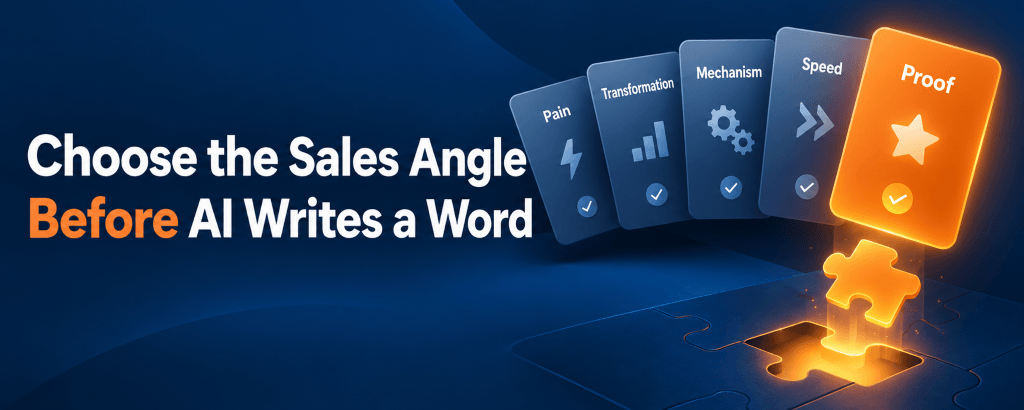
Almost every persuasive argument falls into one of five families. Knowing them turns “which headline sounds best?” into a much more useful question:
which argument does the evidence actually support?
1. The Cost of Staying Stuck (consequence)
Lead with what the current problem is already costing the buyer: lost sales, wasted time, missed opportunities. This works best when the cost is real, ongoing and felt, and when the buyer is already aware of the problem.
2. The Wanted Transformation (desire)
Lead with the result itself. When the outcome is specific and genuinely desirable, the destination does most of the selling. It’s the classic “imagine if…” angle, and it’s strongest when people already want the outcome but don’t yet believe they can get it.
3. The Better Way (mechanism)
Lead with how your approach works differently. This is powerful when buyers have tried the usual routes and been disappointed, because a credible new mechanism explains why the result can be different this time.
4. The Friction Collapse (efficiency)
Lead with the removal of time, effort, complexity or hassle. It suits tools, templates and shortcuts, where the buyer already knows what they want to do and the real objection is “I haven’t got time for that”.
5. The Evidence-Led Case (proof)
Lead with demonstration and proof strong enough that the conclusion feels inevitable: track records, results, numbers, case studies. When you have genuinely strong proof, opening with a promise instead of the evidence is often a waste of it.
Here’s the catch: AI will write a convincing campaign for all five. That’s why the choice has to come from somewhere other than how the copy sounds.
How to choose the right sales angle: an evidence-first process
The fix is simple to describe and surprisingly rare in practice:
decide the argument from evidence first, then let AI execute it. Here’s the process I use.
-
- Write down the evidence, not slogans. Who exactly is it for? What outcome do they already want? What’s the expensive or frustrating problem? What does doing nothing cost them? How does your offer produce the result? Why is your route better? What’s your best proof? What’s the main reason people hesitate?
-
- Rate the evidence honestly. How intense is the consequence? How much faster or easier is your route? How new is the mechanism? How strong is the proof, really? Inflating these is the fastest way to pick the wrong angle.
-
- Consider audience awareness. Problem-aware buyers respond differently from people already comparing solutions. The right angle for a cold audience is often not the right angle for warm subscribers.
-
- Compare all five angles against that evidence. Which one does your evidence support most strongly? Which is a close second?
-
- Pick one lead and one supporting angle. The lead governs the campaign. The supporting angle strengthens it once the main argument has landed. Everything else gets left out, however good it sounds.
-
- Challenge a narrow result. If two angles are neck and neck, treat the winner as a hypothesis. Look for more evidence, or test both.
A worked example: same offer, different evidence, different sale
Here’s a real example. The offer is a training course that teaches people to build a local leaflet distribution business, then grow those clients into bigger services such as design, copy and websites.
The evidence includes something unusually strong: the person behind the model has run it for 17 years, with 1,454 local clients and over 12.6 million items delivered, backed by GPS-tracked route maps and real client reviews. Proof like that deserves a 5 out of 5.
Running that evidence through a structured comparison, the recommended lead angle was
The Evidence-Led Case, scoring 86. Close behind was
The Wanted Transformation on 85. With proof that strong, the sales page shouldn’t open with a promise. It should open with the evidence and let the conclusion follow.
Now the interesting part. Dropping proof strength from 5 to 3, as you would for an offer without that track record, flipped the recommendation. The lead became
The Wanted Transformation (85), with The Cost of Staying Stuck second (83).
Same offer. Different evidence. Different sale. That’s exactly the decision AI normally makes for you, silently, while it’s busy writing the copy.

Common mistakes when choosing a marketing angle
-
- Leading with everything. Blending five angles together produces copy that tries to say everything and convinces nobody of anything in particular.
-
- Letting the first prompt decide. The angle in your first prompt tends to become the angle of the whole campaign, whether or not it was the right one.
-
- Overrating your proof. If your proof is thin, an evidence-led page will feel hollow. Be honest and lead with something the evidence actually supports.
-
- Reopening the decision every week. Once the argument is chosen, stop re-litigating it every time a new AI generation sounds interesting. Test it properly instead.
-
- Asking AI to vote on AI copy. As my naming experiment showed, models tend to agree with whatever case is in front of them.
How to brief AI once you’ve chosen the angle
This is where AI becomes extraordinarily useful again. Instead of “write me a sales page for this product”, give it the decision you’ve already made. A simple brief looks like this:
Governing sales argument: [your lead angle]
Belief we need to create: [what the buyer must believe]
Mechanism: [how the result happens]
Proof to put up front: [your strongest evidence]
Main objection to resolve: [why they hesitate]
Supporting angle: [your second angle]
Structure: [the order the argument should follow]
Now write a [sales page / email / ad] that executes this strategy.
Do not change the governing argument.
AI is back doing the job it’s exceptionally good at: execution. And your headline, emails, ads and social posts all start pulling in the same direction, because they’re built around one argument instead of five.
A tool that does the comparison for you
I liked this process enough to build it into a simple tool.
Now It Fits is a marketing decision engine that runs in your browser. You enter the evidence behind your offer, it compares the five angle families, recommends a lead and a supporting angle, then builds a campaign brief and a ready-to-use prompt for ChatGPT, Claude or whichever AI you prefer.
It doesn’t call an AI to invent your strategy, and it won’t promise you conversions. It gives you a separate place to make the decision, so you can see it, challenge it and then hand AI a clear job to do.
Frequently asked questions
What is a sales angle in marketing?
A sales angle is the core argument a campaign makes for why someone should buy, such as the cost of the problem, the desired result, a better method, a faster route or strong proof. It sits underneath the headline and copy and decides what they say.
Can’t I just ask ChatGPT which sales angle is best?
You can, but AI is very good at justifying whichever option is under discussion, and different models will often give different answers. Use AI to execute the angle, and make the choice from your own evidence first.
How many angles should one sales page use?
One lead angle to govern the page, plus one supporting angle to strengthen it. More than that usually makes the message feel confused.
Does the right angle guarantee more sales?
No. Choosing the angle from evidence improves the quality of the decision, but your offer, audience, traffic and execution still matter. Treat a close result as something to test.
The bottom line
AI can write the wrong sales story beautifully. That’s what makes the problem worth solving. Before you spend another hour rewriting the headline, trying another prompt or asking another model, make the decision first: one offer, five possible stories, and one that genuinely fits.
If you’d like more practical ways to use AI in your marketing, with no hype and no tech waffle, come and join my free community at
Now I Get AI.
READ LATER - DOWNLOAD THIS POST AS PDF >> CLICK HERE <<


