
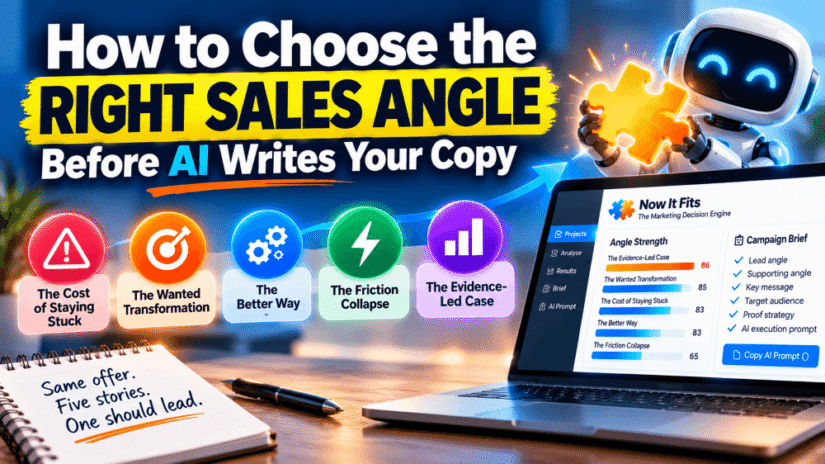
How to Choose the Right Sales Angle Before AI Writes Your Copy
AI has made writing sales copy almost free. Ask ChatGPT or Claude for a sales page and you’ll have a polished draft in under a minute. Headlines, bullets, objections, a guarantee section. All of it reads well.
So why do so many of those pages still fail to sell?
Usually it isn’t the writing. It’s the sales angle: the central argument the whole page is built around. Get the angle wrong and better writing just makes the wrong argument more convincing. Get it right and even plain copy starts to work.
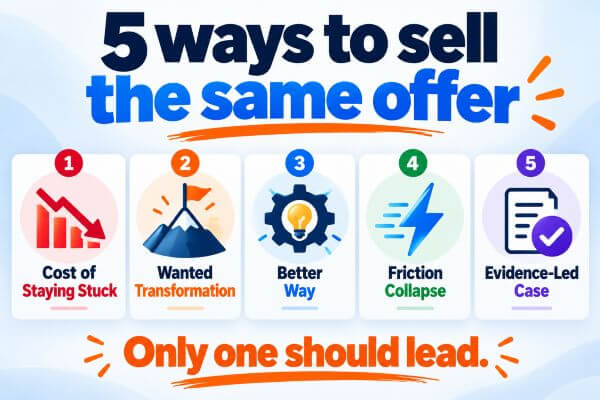
This guide explains what a sales angle is, the five angles almost every offer can be sold with, and a practical way to choose the one that should lead, before you ask AI to write a single word.
What is a sales angle?
A sales angle is the main reason you give someone to buy. It’s not the headline, and it’s not the product. It’s the argument that sits underneath both. Take one product: an online course that helps dog owners stop their dog pulling on the lead. You could sell it by talking about the daily embarrassment and sore shoulders. Or by painting the picture of calm, relaxed walks. Or by explaining a new training method that works where treats and harnesses haven’t. Or by showing it takes ten minutes a day, not ten weeks. Or by leading with before-and-after videos from real owners. Same course. Five completely different pages. Each would attract a slightly different buyer, raise different objections and need different proof. That’s why the angle matters more than any individual line of copy. It decides what the headline promises, what the opening story is about, which benefits get the spotlight, which objections you answer first and what proof you put where.Why AI makes choosing a sales angle harder, not easier
You’d think AI would solve this. Just ask it which angle is best. The trouble is that AI is exceptionally good at making any argument sound persuasive. Ask it to sell on pain and the pain section will be vivid. Ask for transformation and the future will glow. Ask which one is “best” and it will give you a confident, well-reasoned answer, which may simply reflect how you phrased the question. Three things tend to happen:- Everything sounds good. When every draft reads well, you stop being able to tell a strong argument from a merely well-written one.
- Pages become a bit of everything. Without a clear brief, AI blends all five angles into one page. It sounds thorough, but the reader never gets one clear reason to act.
- You fix the wrong thing. When the page underperforms, you rewrite headlines and bullets, because that’s what’s easy to change. The argument underneath stays exactly the same.
The five sales angles every offer can use
Almost any offer can be sold through one of these five angles. Each one asks the reader to believe something different.1. The Cost of Staying Stuck
The argument: doing nothing is already the expensive choice. This angle leads with what the problem is costing right now, in money, time, missed chances or stress, and how that cost compounds. It works best when the cost is real, measurable and already felt by the buyer. It works badly when the problem is mild, because exaggerating it quickly feels manipulative.2. The Wanted Transformation
The argument: the outcome you already want is attainable, and worth prioritising now. Instead of dwelling on pain, this angle paints the after-state. It’s strongest when buyers already know what they want and can picture it clearly: a calmer business, a fitter body, a full calendar. It needs a believable route to that outcome, or it reads as wishful thinking.3. The Better Way
The argument: the old approach fails because it attacks the wrong part of the problem. This is the mechanism angle. It works when your audience has already tried the usual solutions and been let down, so they’re sceptical of more of the same. Your job is to explain, clearly and specifically, why your method changes the odds. If you can’t explain the mechanism in plain English, this angle will fall flat.4. The Friction Collapse
The argument: the result no longer requires the sacrifice you assumed. Some buyers already want the outcome and believe it’s possible. What stops them is the effort: the time, the tech, the learning curve. This angle removes that friction. It’s ideal for tools, templates and done-for-you offers, but only if the ease is genuine. Overpromising simplicity is one of the fastest routes to refunds.5. The Evidence-Led Case
The argument: the evidence makes this safer to believe than to dismiss. When you have strong, specific proof (years of results, numbers, case studies, demonstrations) you can let it carry the page. Lead with the evidence, explain what it implies, then build the case around it. This angle is powerful with sceptical, experienced buyers. Without real proof, it simply doesn’t exist, and it should never be faked.How to choose the right sales angle
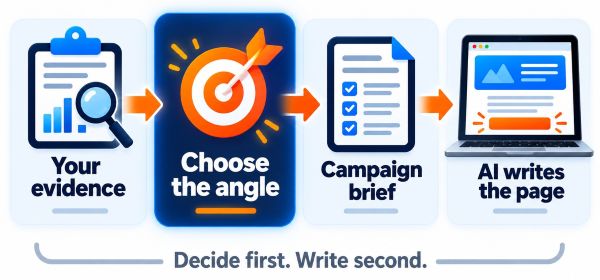
The right angle isn’t the one that sounds best. It’s the one your evidence can support most strongly for this particular audience. Work through these questions honestly, ideally before you open ChatGPT.Step 1: Write down what you actually know
- Who exactly is the buyer? Not “entrepreneurs”. Which entrepreneurs, at what stage, with what frustration?
- What outcome do they already want? In their words, not yours.
- What’s the expensive problem? And what happens if they do nothing?
- How does your offer produce the result? What’s the mechanism?
- Why is your route better or easier?
- What proof do you genuinely have? Results, reviews, numbers, credentials.
- What makes them hesitate? The single biggest objection.
Step 2: Rate the strength of each piece
Give each a rough score from 1 to 5. How painful is the consequence of doing nothing? How new is your mechanism? How much faster or easier is your route? How strong is your proof? Be ruthless. A 5 for proof means you could show it to a sceptic tomorrow.Step 3: Match the angle to awareness
Buyers who don’t yet realise they have a problem need a different argument from buyers comparing three solutions. Problem-aware audiences often respond to cost or transformation. Solution-aware buyers who’ve been burned before respond to a better mechanism or hard evidence. Highly aware buyers often just need the friction removed.Step 4: Pick one to lead, and one to support
Choose the angle your strongest evidence supports as the lead. Then choose a supporting angle to reinforce it later on the page. For example, lead with evidence, then use the wanted transformation to show what that evidence means for the reader. The supporting angle never takes over the headline.Step 5: Turn the decision into a brief
Now write a short brief for your AI: the lead angle, the supporting angle, the benefit, the mechanism, the proof to put first, the main objection and the belief the page needs to change. Tell it to build the whole page around that one argument. The difference in output is immediate.
Common sales angle mistakes
- Defaulting to pain. Pain-led copy is the reflex for most marketers and most AI tools. It’s often right, but not always. If your proof is stronger than your problem, lead with the proof.
- Using every angle at once. A page that argues five things argues nothing. Readers need one clear reason to act.
- Choosing the angle you like. The most interesting angle to you (often the mechanism, because you built it) isn’t necessarily the most persuasive to the buyer.
- Claiming proof you don’t have. If the evidence isn’t there, don’t pick the evidence-led angle and hope AI fills in the gaps. It will, and that’s a problem.
- Testing headlines but not angles. Split-testing two headlines from the same argument tells you little. Test two pages built on two different angles and you learn something real about your market.