

AI is collapsing the value of expertise. Here’s where that money goes — and why an audience is now the core asset for marketers and local agencies.
Artificial intelligence is rapidly reducing the economic value of stored knowledge and of a great many kinds of human thinking. Lawyers, accountants, designers, programmers, consultants, copywriters — even doctors — are now competing with machines that do a large slice of the same intellectual work faster, cheaper, and increasingly better.
Which raises a question I don’t think enough marketers are asking: where does that value go?
Because it doesn’t evaporate. It never has.
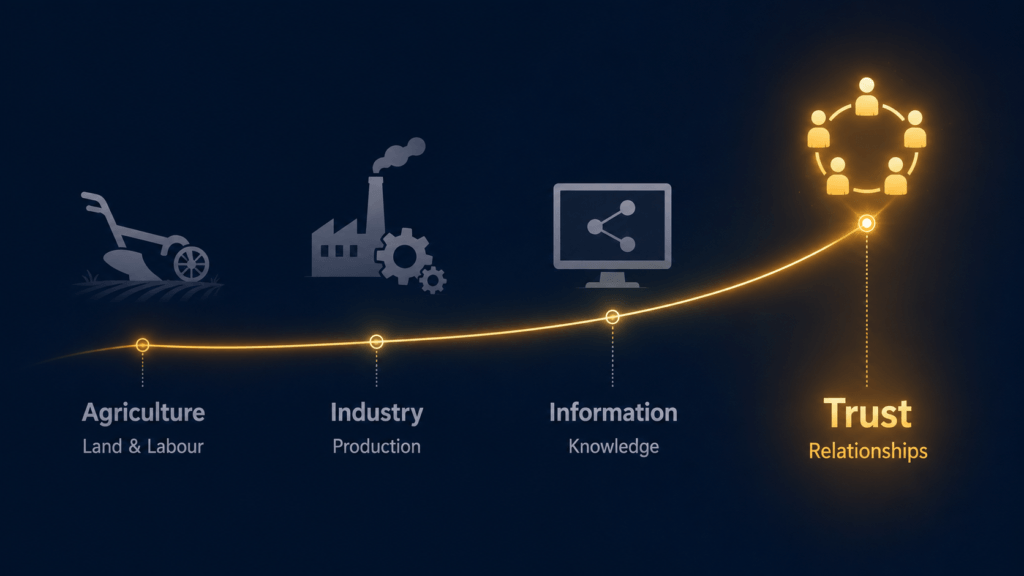
Value doesn’t vanish. It migrates.
Every technological revolution changes what the marketplace is willing to pay for. The plough reduced the value of brute strength and raised the value of farming skill. The Industrial Revolution reduced the value of hand craftsmanship and raised the value of engineering and management. The Information Revolution made knowledge processing absurdly efficient — and made the people who owned the information machines enormously rich.
In every case, something scarce became abundant, and the money moved on to whatever was still scarce.
You don’t need to know whether AI will double the size of the economy or barely nudge it. That argument is unresolvable and, for your purposes, irrelevant. What matters is the direction of travel: intelligence is becoming abundant, so the money is leaving it. The only question worth your time is where it goes next.
The 80% rule most marketers already know
My answer starts with something you already understand if you’ve ever written a sales page. AI is going to change a great deal about how we live and what we buy. It is not going to change our fundamental social and psychological needs.
Look at where consumer spending goes. In poor countries, the bulk of it services physical necessities — food, shelter, warmth. In prosperous ones, the lion’s share is discretionary. And even inside the categories we call “necessities”, something like 80% of what people spend is servicing psychological and social wants, not physical needs.
We buy bigger houses than we need. We buy the £1,000 watch that keeps time no better than the £29 one, because the £29 one cannot deliver status. We join the golf club. We pay the school fees. We do it because we care where we stand in the groups we belong to — we want to be respected, trusted, included, competent, and reassured that we’re not getting it wrong.
Here’s the pattern that matters: as technology makes it steadily cheaper to satisfy physical needs, a growing share of income shifts across to satisfying psychological and social ones. That’s been happening for generations. AI is about to stamp on the accelerator.
When answers are free, trust gets expensive
Picture the world AI is building. Every question produces a dozen intelligent answers. Every product has hundreds of reviews. Every investment idea arrives with a persuasive case for and against. And because AI now generates convincing photos, voices and video, telling the authentic from the artificial gets harder by the month.
I used to assume all this would make everyone smarter. I’ve stopped believing it. The internet already gave us more information than any generation in history. Did it make us more certain about what’s true? It doesn’t look like it. We don’t suffer from a shortage of information — we suffer from an excess of it. AI will magnify that problem enormously.
Which produces an outcome most people get backwards. The result won’t be less demand for human advice. It’ll be more. Faced with an endless stream of plausible answers, people do what they’ve always done — they look for someone they trust to help them decide.
I don’t mean blind faith. I mean something narrower and far more valuable commercially: the willingness to hear someone’s advice and act on it.
You already do this. You use a particular dentist because someone you rate uses them. You have a favourite financial writer. You ask one friend about restaurants and a different one about holidays. That habit isn’t going away. It’s about to get much stronger.
If the central economic story of the AI age is that intelligence becomes abundant, the central business story is that trust becomes scarce. And scarcity is where economic value always goes.

The AI age is a tribal age
We’re all members of multiple tribes, even when we don’t call them that. The followers of a podcaster. The readers of a newsletter. A golf club, a trade association, a Facebook group. Groups of people who take cues from one another — and especially from a trusted voice inside the group — about what to buy, what to believe and how to behave.
Humans have organised this way for hundreds of thousands of years. What’s changed is scale and medium. There are vastly more tribes than there were, most now live on digital platforms, algorithms have made their belief systems sharper, and the biggest are larger than most countries.
The giants — Google, Apple, Meta, YouTube, TikTok — are effectively digital nations. They collect revenue, set rules, and punish rule-breakers with the oldest sanction there is: removal from the group. Those are built. That race is run.
The real opportunity is a long way below them. It’s in the thousands of small tribes with a few hundred or a few thousand members and a trusted voice at the centre — and in the entrepreneurs who understand how to grow them ten-fold and, politely, how to tax them.
What this means if you’re an online marketer
AI is about to drive the cost of producing content to roughly zero. Anyone will be able to publish articles, videos, courses, newsletters and software that look entirely professional. At first glance that reads as catastrophic news. It isn’t — but it does change what the job is.
As content becomes abundant, community becomes scarce. Nobody is short of another 1,000 videos about investing or fitness or affiliate marketing. What they’re short of is judgement they trust and people who share their values. That’s a completely different business from content production — and it’s the one worth being in.
For forty years I’ve argued that the most valuable asset most businesses own isn’t the premises or the equipment — it’s the list. The people who’ve responded to an offer and bought. In the AI age that becomes truer, not less true, because a responsive list isn’t a marketing channel. It’s a tribe. If you’ve earned the trust of 20,000 people and can reach them instantly, you own something AI cannot mass-produce.
So the practical shift is this: stop optimising purely for reach and start optimising for the relationship. Publish with a point of view instead of a summary — an AI will always out-summarise you, and it will never out-conviction you. Put your name on the recommendation. Move people off rented platforms and onto assets you own. And be willing to say “don’t buy this one”, because the no is what makes the yes worth money.
What this means if you run a local agency
Local agencies are sitting on the wrong side of this shift — and are closer to the right side than almost anyone realises.
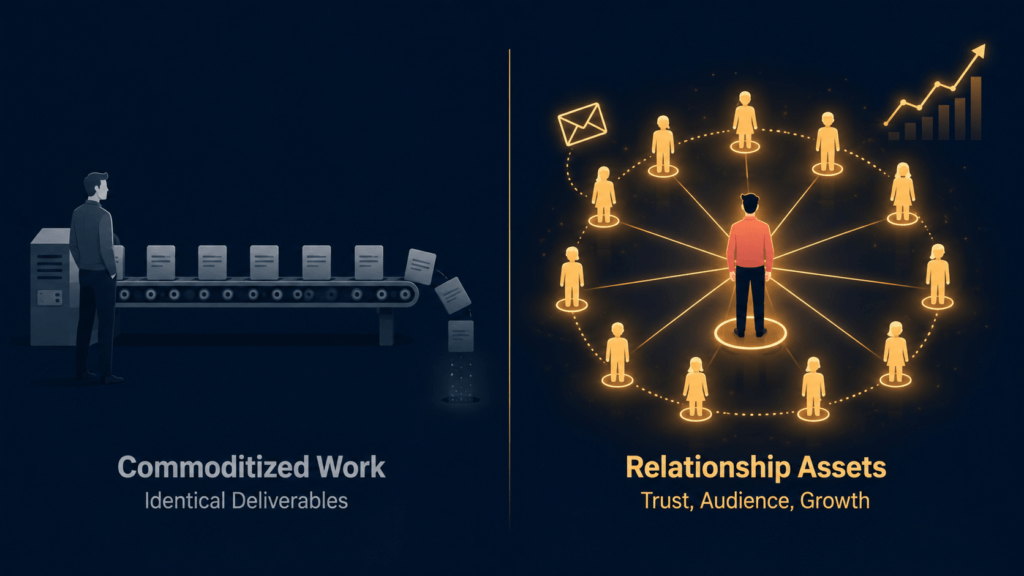
The wrong side first. If you sell hours of expertise — we’ll write your posts, we’ll build your pages, we’ll run your reports — you’re selling exactly the commodity AI is collapsing in price. Your client can already get a passable version of your deliverable for £20 a month. That conversation is coming, and no amount of explaining your process will win it.
Now the right side. You have something the AI-native competitor doesn’t: you are physically embedded in a real tribe. The high street. The chamber of commerce. The local Facebook group with 14,000 members. Local trust is slow to build, awkward to fake, and impossible to scrape.
So stop selling deliverables and start building and owning audiences — for your clients and for yourself.
For clients, reposition from production to community: the customer list, the reviews engine, the local newsletter, the referral loop, the WhatsApp group of best customers. Sell them the asset they’ll still own in five years, not the artefact AI will price at zero next year. Charge for the outcome, not the hours.
For yourself, build the local tribe you’d want to be able to email tomorrow. A newsletter for business owners in your town. An event nobody else can be bothered to run. A podcast where local operators talk about what’s actually working. It compounds in a way cold outreach never does — and it makes you the trusted voice in a market where every competitor is now shouting with identical AI-generated copy.
Employees are paid for skills. Owners are paid for assets.
Plenty of people will earn a very good living helping other companies build tribes — copywriters, community managers, video producers, AI specialists, brand strategists. Those are real skills and they’ll stay valuable.
But the large fortunes won’t go to the people building tribes for someone else. They’ll go to the people who own them. That’s how it has always worked. Employees are paid for their skills; owners are rewarded for the value of the asset they’ve built.
And the asset doesn’t need to be enormous. If you’ve got 3,000 people and you serve them well enough that 300 of them spend £300 a year, you’ve built something most agencies would envy — and you own it outright.
Where to start
You don’t need to predict which model wins or what AI looks like in 2035. None of the conclusions above depend on it. They depend only on the direction of the migration. So measure your next decision against a single question: does this move me closer to where value is going, or does it tie me more tightly to where value has already been?
Concretely, this month: get comfortable enough with AI tools that you’re not intimidated by them — you don’t need mastery, just familiarity. Then pick one audience you could plausibly become the trusted voice for, and start capturing it somewhere you own. Not a follower count you rent from a platform. An email list, a phone list, a room you can fill.
If I were starting over today, I wouldn’t want a job at the world’s biggest company. I’d want a small business with a devoted audience, a trusted reputation, recurring revenue and AI quietly doing the routine work in the background. Less glamorous than building the next trillion-dollar platform — but I think tens of thousands of businesses like that are going to quietly create extraordinary wealth over the next twenty years.
The biggest fortunes in periods of rapid change almost always go to the people who spot the direction of travel early — and start moving while everyone else is still arguing about whether the change is real.
It’s real. Start building your tribe.
I write about this sort of thing — where the money’s moving and what to do about it — to my own list. If that’s useful to you, that’s where the rest of it goes.
Learn more here – https://nowigetai.com

